LISTEN TO THIS STORY:
0:00
/
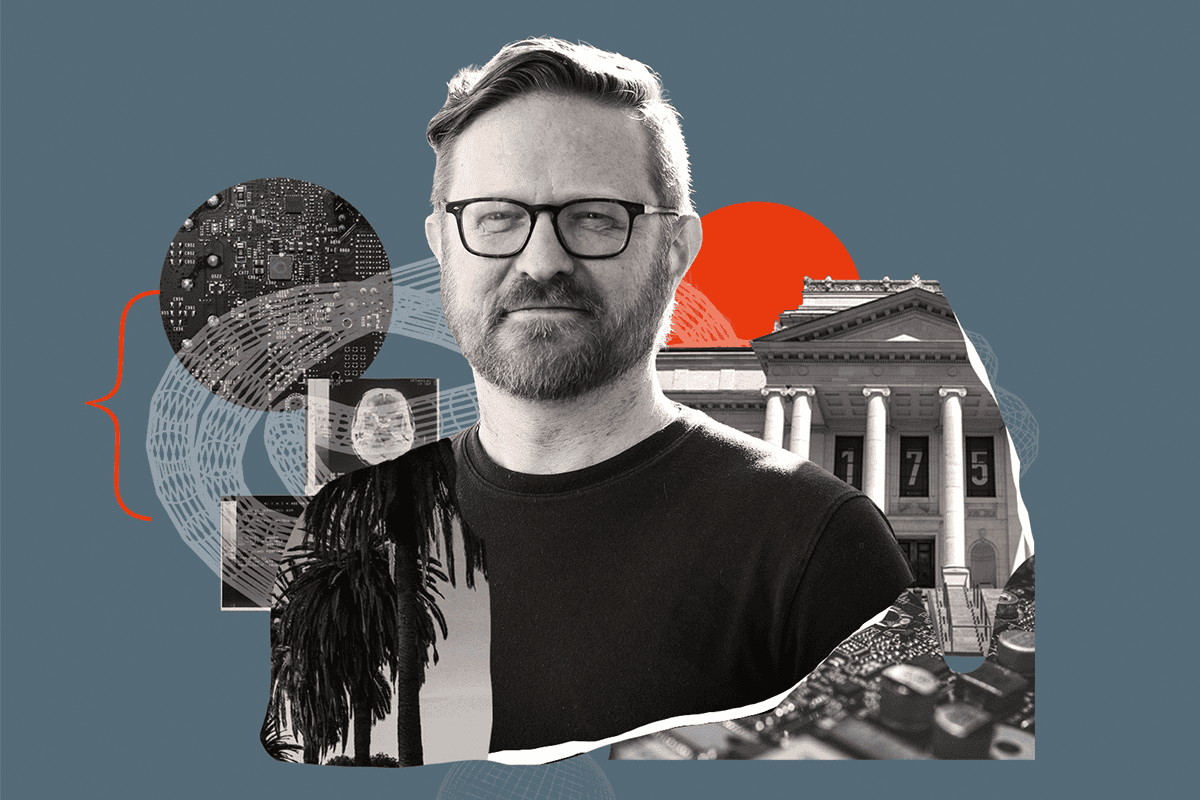
At Blackrock Neurotech, Spencer Kellis develops implantable devices that help people with brain and spinal cord conditions communicate, move and more.
Spencer Kellis started his Ph.D. designing microprocessors like the ones that run our computers and phones. Now, at Blackrock Neurotech, he leads a team that develops brain-computer interface (BCI) tools to help people with brain and spinal cord injuries or conditions gain independence.
This interview has been lightly edited for length and clarity.
The Transmitter: What do you do at Blackrock?
Spencer Kellis: I lead the applications group in the BCI department. The group consists of software, clinical neuroscience and data science teams, and the work spans everything from neuroscience research with academic partners all the way through developing software platforms and algorithms for our BCI systems.
Most days start with 15-minute calls in which I check in with my team and identify any blocking issues or accomplishments from the previous day. I also have weekly one-on-one meetings to discuss everyone’s work and career development more generally. And I meet regularly with leadership teams across BCI and the rest of Blackrock. Those meetings are critical because BCIs are systems made up of many components. There may be teams working on electrodes, algorithms, user interface or software; and other teams running pre-clinical testing, managing clinical trials and regulatory processes, and mapping out business strategy. To build an accessible BCI and get it to market, all these teams have to work closely together. It’s like the old analogy of drilling a tunnel from two sides of a mountain (except in this case, more like six or seven sides): They all better meet in the middle or it’s not much of a tunnel.
TT: What do BCI systems do?
SK: Ultimately, it’s about translating a person’s intent into action. Our systems use small electrode arrays implanted in the cortex to record neural activity and decode those signals to understand what someone is trying to do. The system can then initiate the desired action, whether it’s moving a cursor on a screen or a robotic arm or generating speech. It’s also possible to stimulate the brain to create sensation—the interface can work in both directions.
Researchers at the University of California, Davis recently used our technology to decode the attempted speech of Casey Harrell, who has ALS, restoring conversational communication using a synthesized version of his own voice. And at the Feinstein Institutes for Medical Research, researchers have used it as part of a double neural bypass to help restore movement and sensation following spinal cord injury. The longest continuously implanted research participant using our technology has had his BCI for more than 10 years.
TT: It sounds like a mix of neuroscience and electrical engineering.
SK: You know, I’ve never taken a neuroscience course ever in my life, even though all my jobs have been in neuroscience.
TT: How did you get into neuroscience without ever having taken a neuroscience course?
SK: I did my Ph.D. at the University of Utah in VLSI—very-large-scale integration—which is all about integrated circuits. The lab I joined was part of a larger research group funded by the National Science Foundation to build a wireless implantable cochlear prosthesis. Once that prototype was done, the group decided they wanted to build something for the brain. This was back in 2009 or 2010, and nobody in my lab knew anything about the brain or what a system implanted in the brain should be able to do. There was a company nearby doing brain implants called Cyberkinetics, which is now Blackrock, and I got an internship there for some experience. Through the internship, I met a neuroscience professor at the University of Utah and ended up starting a project with him during my Ph.D. on micro-EEGs—fine microwires that record field potentials at the surface of the brain.
TT: That sounds like some immersive neuroscience training!
SK: I remember naively thinking that neuroscience must be pretty easy; you just have to memorize the different parts of the brain and what they do. I didn’t appreciate the depth of critical thinking and experimental design required to do neuroscience well and was confronted with that quickly when I got to the California Institute of Technology for my postdoctoral work and joined a hardcore neuroscience lab.
TT: What led you to Caltech?
SK: When I finished my Ph.D., the professor I worked with on micro-EEGs got me an interview with Richard Anderson at Caltech. I got the position, and the very first thing I had to do was write an investigative device exemption application to the Food and Drug Administration (FDA) to run a clinical study of an implantable electrode array for quadriplegic individuals. It’s kind of a wild thing in retrospect that a brand-new postdoc with zero experience whatsoever was writing an application to the FDA. I had a ton of help, though. The application got approved, and we moved onto recruitment. I spent the next 10 years—5 as a postdoc and 5 as a staff scientist—running those clinical studies.
TT: What was it like working with patients?
SK: The first participant we implanted ended up becoming a dear friend. He was a spinal cord-injured patient. He grew up in inner-city Los Angeles, a very poor immigrant from El Salvador and a gang member. I’m so grateful for the coincidence of the two of us getting put together in this very unique experience. Sadly, he passed away about two years ago, which was really tough. I’m still friends with his kids and went to his daughter’s birthday party two weeks ago. It was a wonderful experience for me, getting to know him. And I developed a much deeper understanding of what the science meant for a person who might actually use it.
TT: Why did you decide to move to industry?
SK: In 2021, I got a call from a friend who invited me to interview with one of the BCI companies. I got the job offer, but I was pretty happy to continue in academia—although I didn’t really want to be a tenure-track faculty member. I needed to give an answer to this company, though, so I called up a friend from my Ph.D. lab who had been at Blackrock for 10 years. I said, “Hey, I’ve got this job offer, and I’m trying to figure out what to do. Any advice?” And he said, “Actually, I’m trying to hire somebody like that. Why don’t you come work for Blackrock instead?” They were willing to let me keep an academic position and travel back and forth between Salt Lake City and Los Angeles, so all the pieces just kind of fell together.
TT: What is your academic appointment?
SK: My appointment is actually at the University of Southern California in the Department of Neurosurgery. I work for them one day a week, technically, though I spend every other week in L.A. I work closely with a neurosurgeon, Brian Lee, who does a lot of their epilepsy surgeries. We’re currently looking at how seizure activity spreads through epileptogenic tissue, again using brain implants. This research is totally unrelated to my work at Blackrock.
It’s nice to be grounded in an academic community. Over the years, I’ve taught a little bit, joined some committees, reviewed courses for the medical school, and things like that. It’s also very useful to have an academic connection—almost like a credential to talk to people in that world.
TT: What advice do you have for scientists looking to move into industry?
SK: It seems people are a lot more cognizant today than I was of paths outside of academia, which is great. I think internships are a wonderful opportunity to explore what’s out there, and I highly recommend them. The challenge is that there probably aren’t enough internships available for all the people that would like one—we get hundreds of applications for the positions we open and can only take a few people. But it’s worth exploring, and it’s important to reach out and talk to somebody as opposed to just submitting your resume. That’s something I appreciate a lot more now, being on the hiring side of things. If I know who you are, then I’ll think about you when I’m deciding who to hire. If you’re just a resume, there’s a much smaller chance I’ll understand what kind of possibilities you bring.
Also, don’t be afraid to reach out to people to ask them about their roles and how they got them. I’m quite introverted, and it’s not in my nature to cold call or email people. But again, being on the other side of that, I’ve appreciated when people have reached out.