Leia este artigo em português.
Latin America is one of the most biologically rich regions on Earth, home to a vast, varied patchwork of ecosystems. Scientists there leverage this biodiversity to ask questions about the brain, using species found nowhere else and often outside their labs in the field.
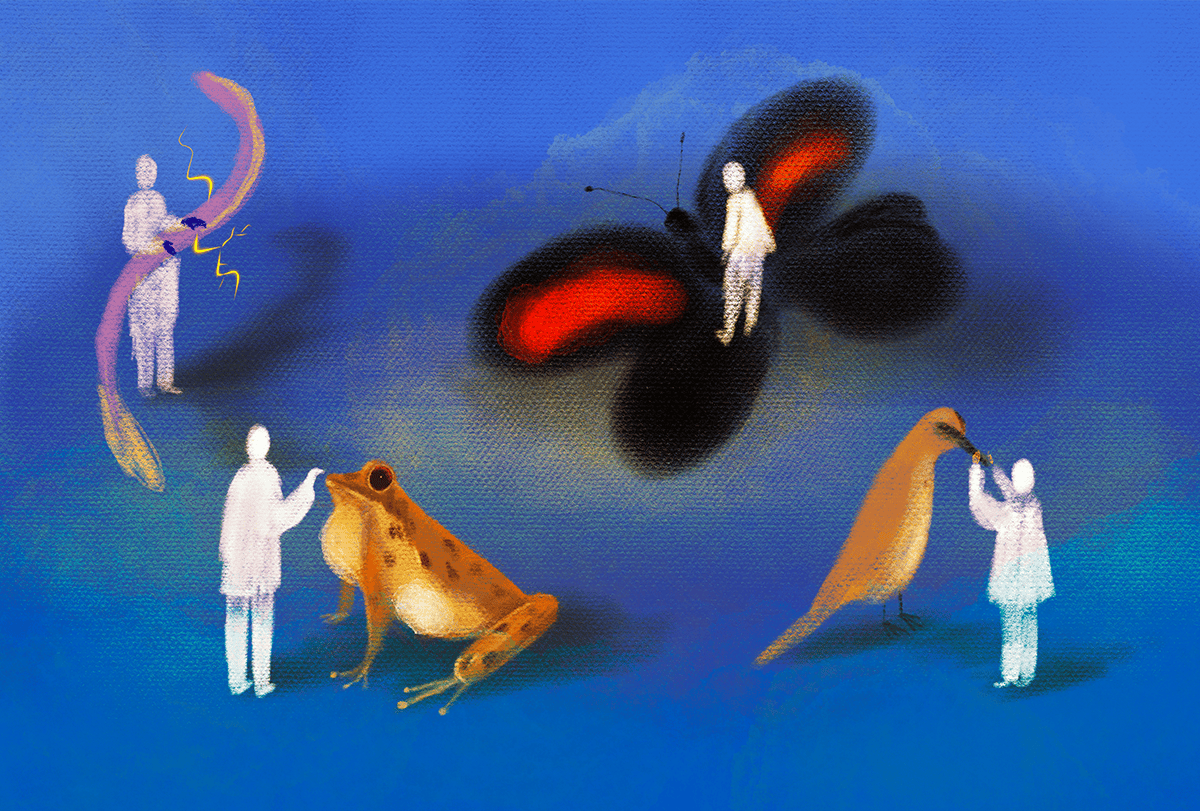
Though not new to the region, neuroethology has grown steadily over the past decade as independent researchers have established new animal models. Among those models are frogs, butterflies and songbirds in Uruguay, Colombia and Argentina, which are helping scientists build insights into communication, mate choice and social behavior in naturalistic settings. Studies have pinpointed the genes that drive aggressive behavior in weakly electric fish and elucidated the neural circuits behind predation and escape in crabs.
“Latin America is this huge experimental field station that we maybe haven’t fully taken advantage of,” says Paula Pouso, associate professor of histology and embryology at the Universidad de la República in Montevideo. “Every time we go to the field we bring back new questions, because just observing the behavior, what happens, opens up so many questions.”
The region offers an opportunity to study species that are otherwise inaccessible, often in abundance, and for little cost—a necessity in countries where funding is often scarce and unpredictable. Researchers living in the Southern Cone of South America, in particular, say that the local ecology makes it possible to establish a research community close to home.
Check out our collection of articles on current neuroethology research in Latin America:
Finding what makes a songbird’s song unique
Parsing neuropeptides’ effects on tree frog song
Discovering how butterflies choose their mate