LISTEN TO THIS STORY:
0:00
/
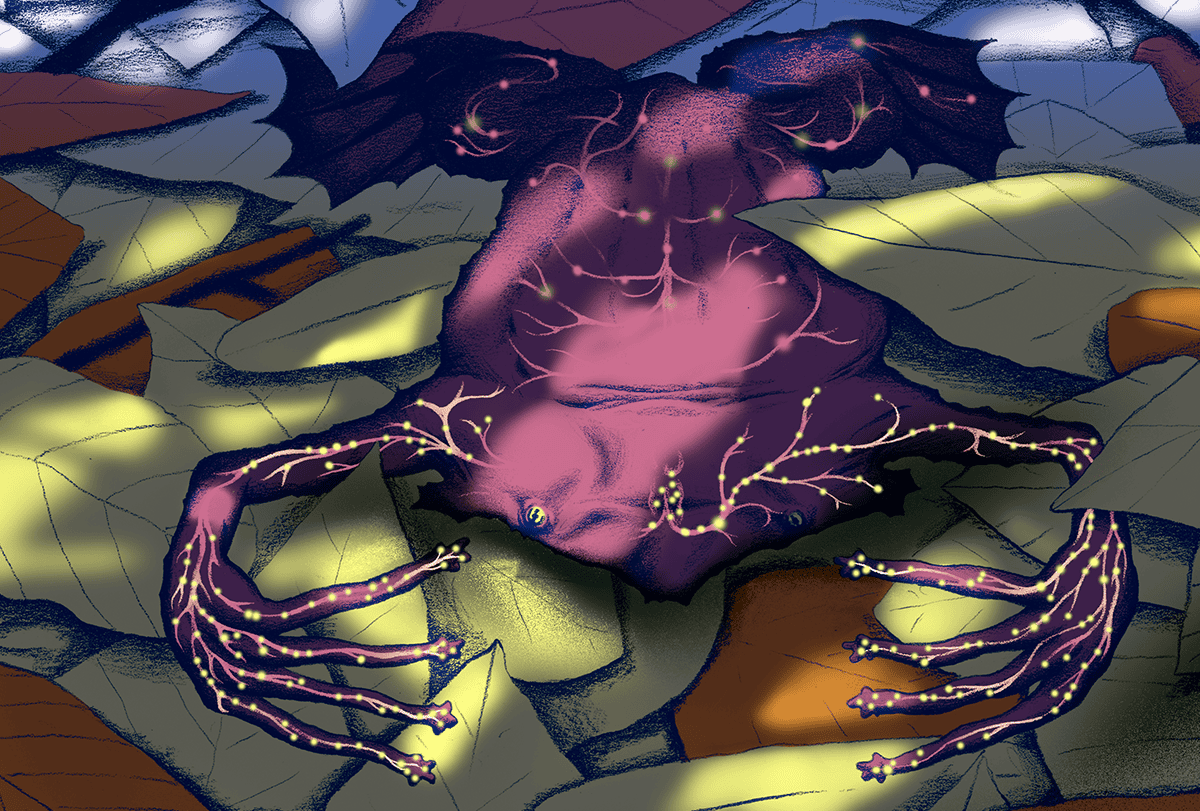
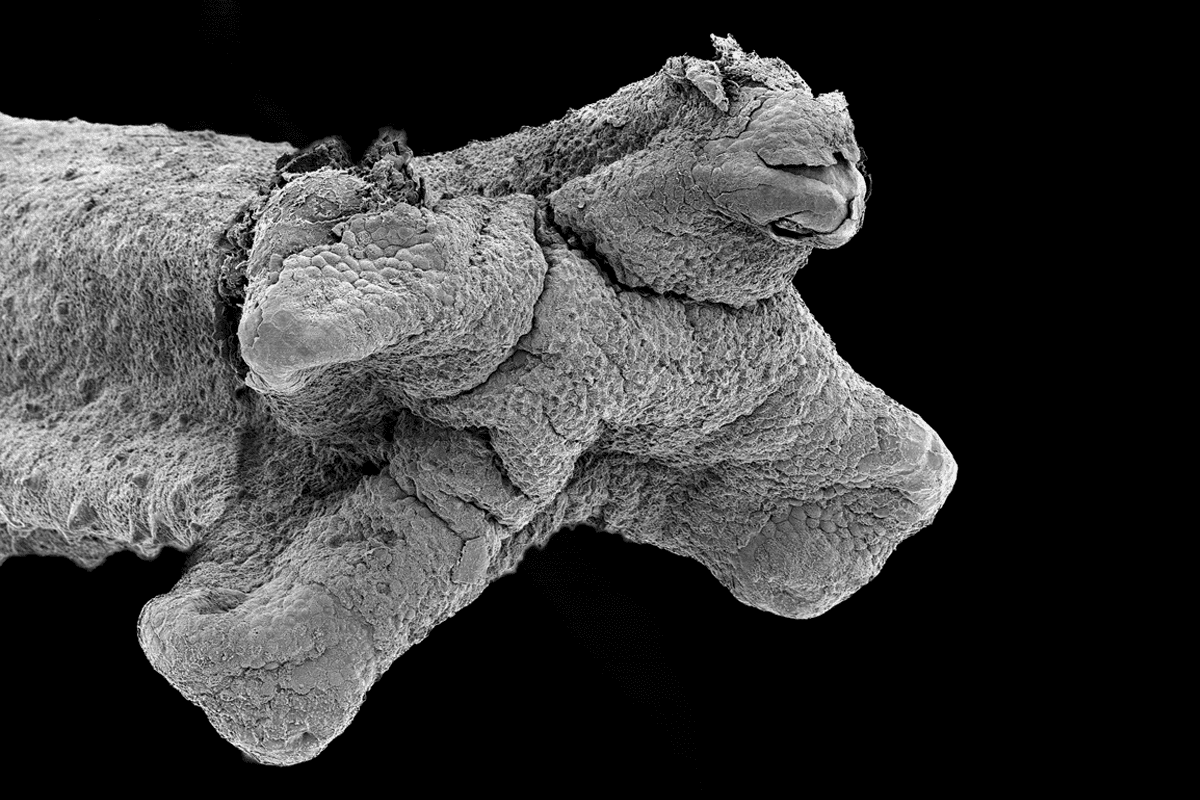
Each of the frog’s eight fingers branches into 16 ultra-sensitive tips, which together function as a fovea—potentially the first demonstration of this type of sensory structure outside of mammals.
The frog Pipa pipa is an effective hunter, yet it doesn’t chase its prey. Instead, the aquatic frog lies in wait, motionless at the bottom of a muddy river bank, arms outstretched like a pair of goalposts. When a tasty fish or worm swims by, the frog sucks the animal into its tongueless mouth and swallows it whole.
This hunting prowess relies on the frog’s sense of touch, according to a recent paper from the lab of Duncan Leitch, assistant professor of integrative biology and physiology at the University of California, Los Angeles. Without any visual cues, the frog can successfully snatch a fish swimming near—but not touching—its hands, high-speed camera recordings showed.
Both of the frog’s front limbs have four fingers that split into four branches, each of which also splits four ways—resulting in 64 ultra-sensitive fingertips per hand. “They might be trying to expand their sensory surface,” Leitch says, “almost like an antennae.”
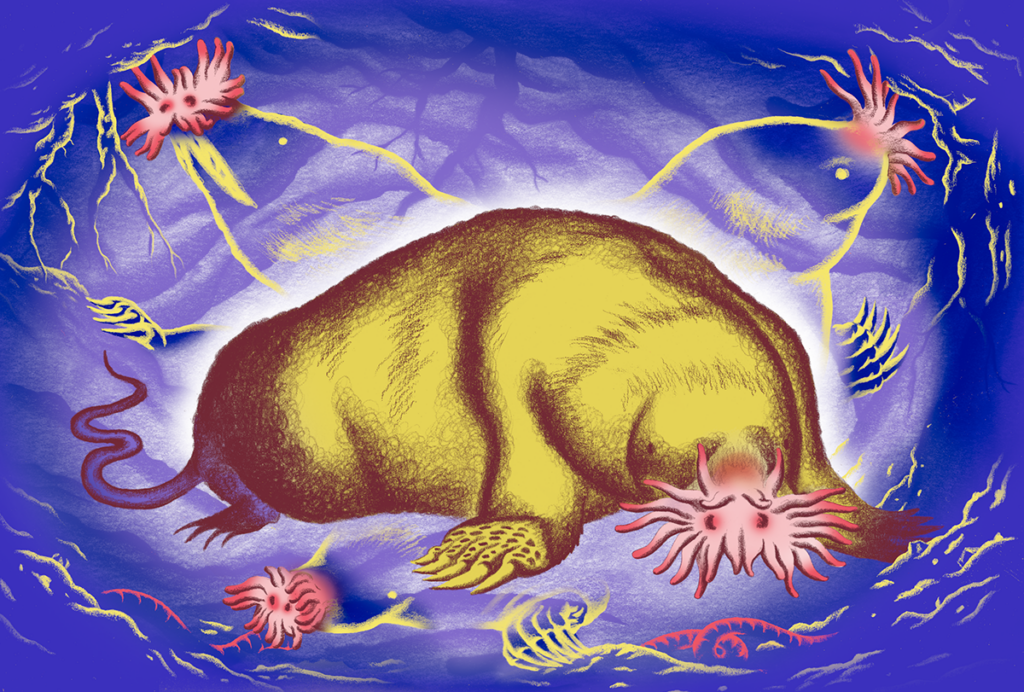
The fingertips compose only 8 percent of the forelimbs’ surface area, yet their representation occupies 34 percent of the forelimb space in the optic tectum, a brain area homologous to the sensory cortex of mammals. As a result, Leitch and his colleagues propose that the fingertips function as a fovea, a sensory structure with heightened sensitivity and receptor density that is overrepresented in the brain—akin to the fovea in the retina or the somatosensory star of the star-nosed mole.
Leitch spoke with The Transmitter about the joys of observing animals, the advantages of a fovea and the mouse work he is most excited about.
This interview has been edited for length and clarity.
The Transmitter: What inspired you to study the pipa frog?
Duncan Leitch: I’ve always really appreciated and loved herpetology, looking at reptiles and amphibians. That’s been my very favorite since I was a kid. So I was aware of pipa frogs just from looking at old books where they would show all the strangest frogs and lizards, snakes that can fly, things like that. Pipa was in there mostly because it has this very weird reproductive strategy where the eggs are placed on and become embedded in the skin of the back of the mother. The eggs go through development and emerge as a fully functional little frog from the mother’s back. I had seen weird images of this, and then I had a chance to see them hunt in the zoo. We brought them into the lab and then started to watch them with a high-speed camera.
TT: Did you expect they were using their sense of touch to hunt?
DL: Not at first. It reminded me of some previous work that I had done with tentacled snakes. They’re almost completely motionless and exploit an escape response in fish—they force the fish to swim towards [the exact spot] where they’re going to move their mouth. I thought that might be what’s happening with these pipa frogs.
But by using high-speed video and watching them in detail, and then with further work looking at the anatomy, as well as the way that their brains are wired, we started to focus in on their sense of touch.
TT: When did you start to think of the fingertip lobules as a fovea?
DL: That started taking shape when we looked at the representation of the body surface within the central nervous system (CNS). We saw a greatly exaggerated representation for the smallest surface area of these lobules, just the most distant tips of their fingertips, and the rest of the arm and most of the body had a proportionally much smaller area. They also position their fingers in a specific way to take in information. Everything was starting to converge on the idea that this might be a specific area of the body related to touch that is magnified from the periphery all the way into the central nervous system.
TT: In the paper, you point out that this is potentially the first demonstration of a fovea in a nonmammalian nervous system—what does that say about the value of the fovea as a sensory strategy?
DL: A fovea can be a common motif of the way animals segregate different modules of their sensory system and dedicate it to specific functions. It’s a way to have a more straightforward line of communication from the outside world to an area of the brain that’s dedicated to processing that specific modality of information.
There is some level of the behavior shaping this back and forth. Animals will manipulate the fovea to make sure that it’s in the sweet spot to take in the important information, just like the way our eyes make saccadic eye movements to reorient the fovea to whatever we’re trying to see. Animals are moving that sensory surface to make sure that it comes into proximity with important things.
TT: What questions do you want to investigate next?
DL: It’s really cool thinking about the development of the fovea. When pipa frogs are juveniles, their fingertips are only split into four, and later there is the further quadrification to make the 16 little lobules per digit. It would be interesting to see how that might change the representation within the CNS—if there’s already an area primed to become responsive to those digits or if representation is in sync with the periphery of the body so that as it becomes more elaborated, the CNS representation becomes more exaggerated.
TT: In addition to studying the pipa frog, you have also worked with alligators, hummingbirds, sharks and tentacled snakes. What’s the value of studying non-model organisms?
DL: There was a Danish physiologist named August Krogh who hypothesized that for any question within physiology, there will be some animal that is most suited to answer that question. It’s been interesting to see if animals that have unusual anatomy or behavior might be demonstrating how something works more broadly. What you find time and again when studying these strange systems is that a lot of the same principles of how things work are conserved all the way up, even in people.
TT: Do you think there’s too much mouse work in neuroscience?
DL: It’s a very different perspective on biology. I respect that work, and I definitely have benefited from it. Work on the barrel system and whiskers in rats has informed some of the methods that I might use in trying to look at some of my creatures. But I definitely am excited about some of the newer work with mice, where I see them doing more natural behaviors—hunting crickets, things where they’re living in more natural environments—because I think mice themselves probably can do a lot of really cool things, too.