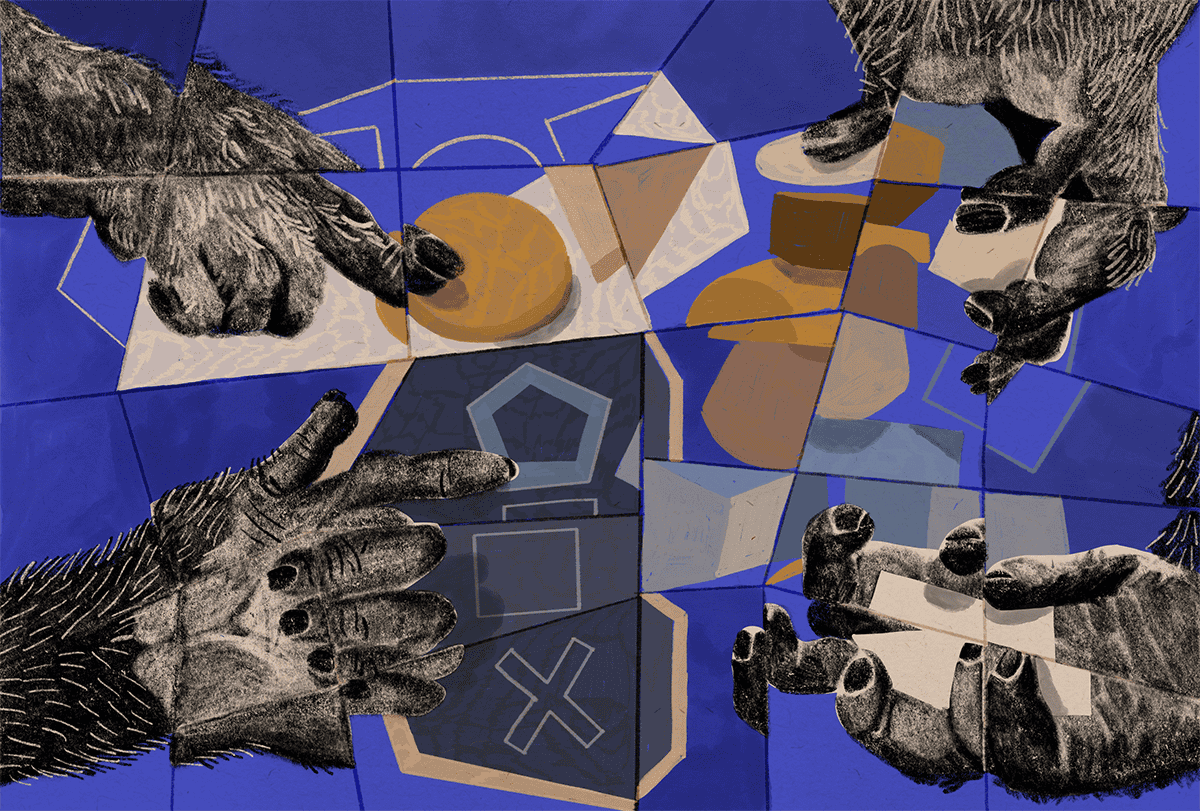
Illustration of primate hands interacting with objects of cognitive tests.
Similar species: The similarities between the monkey and human brain make nonhuman primates a valuable model of human cognition, motor control, development and vision, among other topics.
Illustration by Julia Jabur
Add us as a Preferred Source on Google

The neuroscience questions that need nonhuman primates

The Transmitter asked 17 neuroscientists what questions might remain unanswered if support for nonhuman primate research continues to decline.

By Alissa de Chassey
9 October 2026 | 10 min read

If you were to assess the state of biomedical research in the United States based on the recent actions of its federal health agencies, you might think animal research was a thing of the past. 

In the past year, the Food and Drug Administration shared plans to end all animal testing by 2030, the Centers for Disease Control and Prevention shuttered its nonhuman primate program, and the National Institutes of Health announced its intention to prioritize studies involving animal-free alternatives, such as organoids, computer models and other new approach methodologies.

“It is an exciting time, that some of these novel approaches are coming to fruition. But they’re really not quite ready to replace whole animals,” says Jay Rappaport, director and chief academic officer of the Tulane National Biomedical Research Center.

For example, computational models and brain organoids lack perception, bodily input and cognition. And even though neuroscientists use many animal models to study the brain, the monkey brain is the most similar to the human brain—their evolutionary proximity makes nonhuman primates uniquely suited to answer questions about primate vision, cognition, motor control, social behavior, development and aging.

For now, there is no substitute for nonhuman primate research, says Jonathan Pillow, professor at the Princeton Neuroscience Institute. Although advances in artificial intelligence have fueled speculation that virtual brain models could one day replace animal studies, that future remains distant, he says. “We don’t know enough about the brain yet.”

The Transmitter asked 17 neuroscientists who have worked with nonhuman primates what questions might remain unanswered if support for nonhuman primate research declines. Here is what they told us.
Vision

Many aspects of the human visual system cannot be studied in any animal other than nonhuman primates, says Cristopher Niell, professor in the Department of Biology and Institute of Neuroscience at the University of Oregon.

For example, although mice have a visual cortex, it is limited in scope, size and “probably limited in importance” compared with primates, says J. Anthony Movshon, professor of neural science and psychology at New York University, who uses macaques to study vision and the control of behavior linked to visual information. And mice do not have trichromatic color vision, as humans and monkeys do. 

Mice and primates also process visual information in fundamentally different ways. Mice have nearly panoramic vision, whereas the forward-facing eyes of primates afford binocular vision with a narrower field of view but greater depth perception. Mice also lack a fovea—a specialized region of the retina responsible for primates’ high-acuity vision. And unlike primates, which typically move only their eyes to look around, mice couple their eye movements with head rotations.

Monkeys can also more easily learn to perform visual tasks, such as distinguishing between images of fruit, while researchers track their eye movements. It can take four days for a rodent to learn such tasks, whereas a monkey can learn them in “three or four trials, based on how much reward they’re getting,” says Bruno Averbeck, chief of the Section on Learning and Decision Making at the National Institutes of Health. 

Some of the unresolved questions in vision include: 

  • How does the cortex transform crude visual information into complex representations of objects and motion? 
  • How does the brain integrate high-resolution foveal vision and lower-resolution peripheral vision? 
  • What is the cortical circuitry that processes trichromatic vision?
  • Which neural-circuit changes produce the characteristic eye-movement patterns associated with different neurological and psychiatric conditions?

Cognition

Compared with all other animals, primates have larger prefrontal and association cortices, which power complex cognitive skills such as interpreting sensory information, forming abstract thoughts and making decisions. Popular lab animals such as mice “can have levels of abstraction, but it’s nowhere close to the level that primates have,” says Shushruth Shushruth, assistant professor of neuroscience at the University of Pittsburgh. Birds have some advanced cognitive abilities, but their brains have a different neural architecture, suggesting their skills evolved in a different way.

Humans and monkeys have a much larger lateral prefrontal cortex than rodents, and they accomplish decision-making in a completely different way, says Theresa Desrochers, associate professor of brain science at Brown University. 

Thus, monkeys are the animals that may give us insight into our own inner cognitive lives and help us understand what thinking is, says Mark Churchland, professor of neuroscience at Columbia University’s Zuckerman Institute.

Some of the open questions in cognition include:

  • How do neural circuits support flexible reasoning when animals must infer an abstract rule from limited information?
  • How do neural circuits maintain information over time while simultaneously incorporating new information?
  • How does the brain simultaneously represent and coordinate information unfolding over different timescales—from seconds and minutes to days and years?

Motor control 

Primates stand out from other animals for their advanced hand functions and different types of grip. 

“When it comes to dexterous motor behavior, nonhuman primates are by far the ideal model, because they have similar motor behavior, whether it’s reaching or grasping, or generally in comparison to humans, as opposed to rodent models,” says Jonathan Michaels, assistant professor of neuroscience at York University. 

For example, mice lack the direct cortico-motoneuronal connections from the primary motor cortex to spinal motor neurons that are found in primates, Michaels says. Those connections enable the precise control of individual fingers that underlies skilled hand movements. Michaels’ long-term goal is to fully understand the process of motor control learning. “Now, with the kind of neural recording technology we have, it is more feasible to say that we’re going to understand the learning process,” he says. 

Many neurological disorders—including Parkinson’s disease, stroke and ALS—impair movement by disrupting the brain circuits that plan, initiate and control voluntary or involuntary actions. To understand how these circuits fail, researchers need to observe the activity of individual neurons and neural networks as animals perform movements.

Because humans recover far less effectively from cortical stroke than rodents do, Churchland says, studying nonhuman primates is more relevant. “The symptoms that humans have are very, very different following a stroke to the motor cortex than the symptoms that a rodent would have,” he says.

The same reasoning applies to Parkinson’s disease: “Knowledge gained from anatomy in the monkey allowed people to make educated guesses regarding where they should intervene within the basal ganglia in order to treat the symptoms of Parkinson’s disease,” Churchland says. Studying nonhuman primates provides a crucial bridge to understanding motor control in the human brain.

Some of the unresolved questions in motor control include: 

  • What mechanisms enable learning new motor skills?
  • What mechanisms underlie the flexibility to repurpose motor skills in new contexts and scenarios? 
  • How do large populations of neurons work together to generate voluntary movements?
  • Why does the primate motor system recover so poorly from stroke compared with the rodent motor system, and how can recovery be improved?
  • How can understanding primate motor circuits lead to better treatments for movement disorders such as Parkinson’s disease?

Social behavior and emotion

Unlike rodents, macaques can experience affective states mirroring all kinds of human neuropsychiatric disorders, including conditions such as depression, anxiety, obsessive-compulsive disorder and autism, says Katalin Gothard, professor of physiology at the University of Arizona. “In rodents, their main emotion is kind of the worry to stay alive,” she says. She studies the amygdala neurons that respond to facial expressions and faces in rhesus macaques, and how a monkey maintains its individuality and the sense of self-worth. “They’re incredibly resilient,” Gothard says—the only thing they cannot handle, like people, is isolation.

Primates form long-term relationships, including social hierarchies, alliances and family bonds. Many neural circuits involved in social cognition—particularly in the prefrontal cortex and the amygdala—are developed and organized similarly to those in humans. Although they don’t have language, many nonhuman primates use sophisticated vocalization, facial expressions and gestures. “If a monkey makes eye contact with another monkey, the neurons go from zero activity to a lot of activity,” Gothard says. “That’s an experiment you cannot do with mice or rats; very few other animals make eye contact.” 

Some of the open questions in social behavior and emotion research include:

  • How does the brain build and use models of other individuals in social environments?
  • How do prefrontal and temporal cortical circuits involved in social gaze and attention support the inference of others’ internal states during social interactions?
  • What role do social connections play in the brain’s recovery from social isolation?
  • How do social developmental trajectories shape individuality and social dysfunction linked to the prefrontal cortex?
  • What neural mechanisms explain how lasting social connections help prevent relapse in addiction?
  • How do neural circuits process faces during real-world social interactions?
  • What cellular and circuit mechanisms underlie differences in face perception?

Development and aging

Finally, nonhuman primates are particularly valuable for studying brain development because key windows of change are long enough to be significant to the animal yet still short enough to be studied experimentally. For example, gestation in monkeys lasts four to six months and mirrors the fetal development of humans, whereas rodent gestation resembles only the first two trimesters of human gestation. And adolescence lasts only about four weeks in rodents but spans two to three years in a monkey, Averbeck says. “It is a much more protracted process in primate.” 

By comparing functional MRI data from adolescent humans and monkeys, Averbeck observed that the gray matter does not actually become thinner in the cortex during adolescence, as previously thought. Instead, “the white-matter myelination is encroaching on the deep layers of the cortex,” he says. And, unlike with human fMRI studies, researchers can then cut and stain the monkeys’ brain tissue to look for cell bodies. 

Without nonhuman primate research, researchers could still flag candidate disease mechanisms in cellular and rodent models and find clinical associations in human populations, says Noah Snyder-Mackler, professor of biology at Arizona State University. “What we would lose is the ability to determine, within a naturally aging primate, whether a lifetime exposure changes a specific brain cell population, whether that change disrupts a circuit and cognition, and whether a targeted intervention can prevent it—all while capturing measures that translate directly to humans.”

Some of the unresolved questions in development and aging include: 

  • How do physical forces determine the shape of the brain as it grows during gestation?
  • What cellular changes drive the cortical thinning observed during adolescence? 
  • How do changes in brain circuits across the lifespan contribute to cognitive decline and vulnerability to neurodegenerative disease? 
  • How do changes in sex steroids, including those associated with menopause and hormone therapy, affect brain circuits, cognition and vulnerability to neurodegenerative disease? 
  • How do differences in life expectancy among species shape patterns of brain aging and vulnerability to neurodegenerative disease? 
  • Which life-course exposures—such as early adversity, social support, diet and infection—accelerate or protect against brain aging, and during which windows? 
  • Are age-related brain changes reversible, and can targeted interventions alter their trajectory before symptoms appear? 
  • Can blood, cerebrospinal fluid and imaging biomarkers accurately reveal specific brain-cell and circuit changes before cognitive decline begins?

With additional reporting by Calli McMurray.

Sign up for our weekly newsletter.

Catch up on what you missed from our recent coverage, and get breaking news alerts.