LISTEN TO THIS STORY:
0:00
/
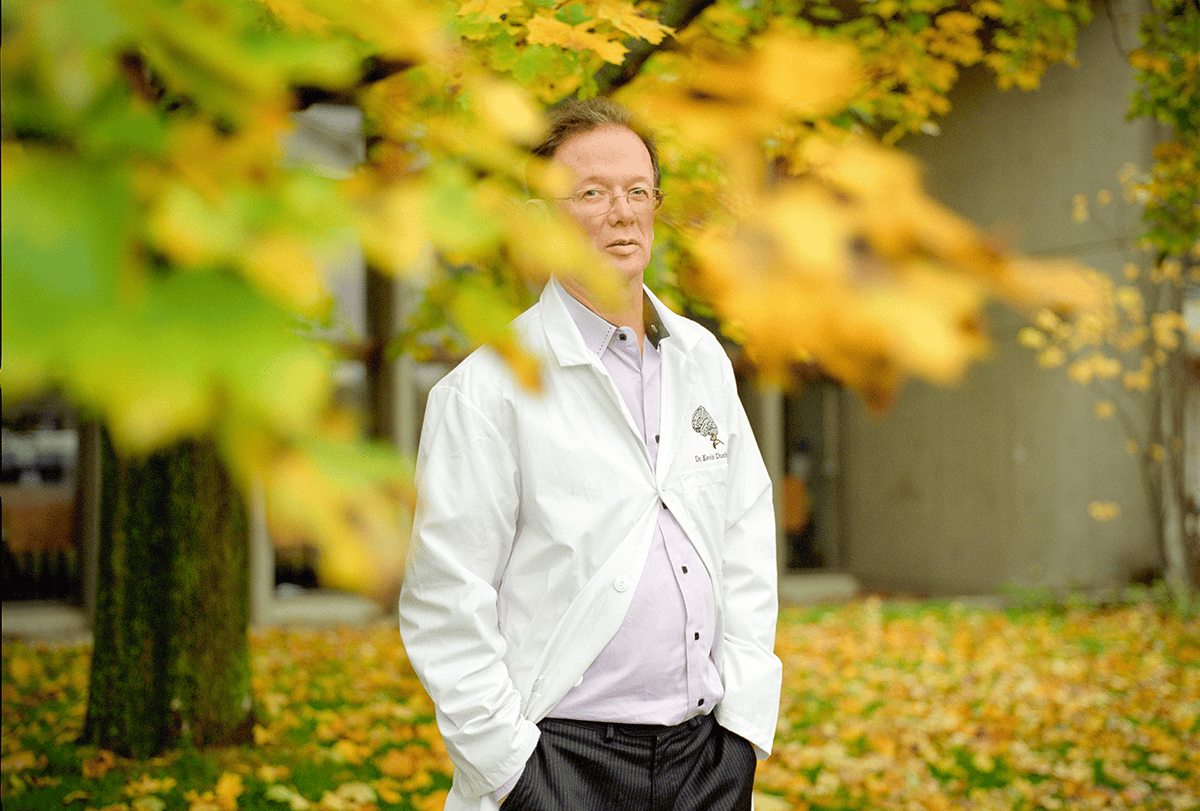
Using imaging technologies, he transformed our understanding of how creativity and scientific discovery arise in the brain.
During a one-year sabbatical at Stanford University in the early 1990s, Kevin Dunbar watched other scientists think. And as he observed them debating in lab meetings, conducting experiments and carrying out day-to-day activities, he became fascinated by how new ideas emerge, says Jonathan Fugelsang, a former collaborator.
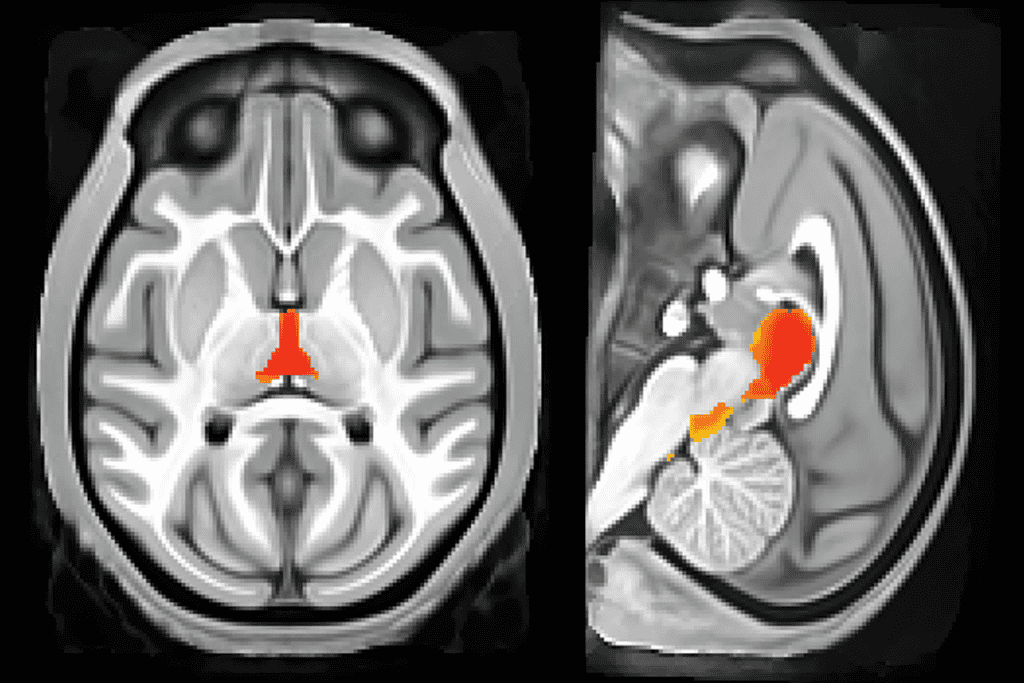
Dunbar carried that fascination with him to a subsequent professorship at Dartmouth College, where he began to study what was happening in the brain during these moments. An investigation of the neural mechanisms of analogy soon revealed orange-ish spots on group-level brain images.
Dunbar beamed with excitement when he first examined those findings, says Fugelsang, now professor of psychology and cognition at the University of Waterloo. The images helped to identify the frontopolar cortex as an integrator of semantically distant information, “basically the place that makes creative connections,” says Adam Green, another collaborator and now a lab director at Georgetown University. “It’s a pretty humbling experience to be the first humans to ever see how something fundamental to human thinking has always worked.”
Dunbar, who died on 20 May at age 70, also helped establish educational neuroscience, a field that brought cognitive neuroscience, psychology and education into closer conversation, co-founding one of the first centers at Dartmouth. But throughout his career, he remained intrigued by how scientists move from observation to breakthrough.
He wanted to “rip that open, to lay open that process of insight” that leads to discovery, says Laura-Ann Petitto, Dunbar’s wife and fellow neuroscientist.
D
unbar was born in Birmingham, England, on 4 January 1956 to Irish parents who had emigrated for work. But the family returned to Ireland not long after, and Dunbar attended Presentation College Bray for secondary school, where “he was always the little nerd in the family” and in school, Petitto says. He was passionate about science but also had interest in literature and the human mind.He attended University College Dublin to earn a B.A. and then an M.A., both in psychology and logic. He needed to take the Graduate Record Exam to continue his graduate studies, but when he showed up at the exam site, there was only one remaining test available for both him and another waiting student. They flipped a coin, and Dunbar won. He enrolled at the University of Toronto the following year, where he earned his Ph.D. in psychology.
In 1986, McGill University had an opening for a faculty position studying “the discipline of higher cognition,” says Petitto, who was assistant professor of psychology there at the time. When he was hired, “his office was put right next to mine,” she says. They married three years later and eventually had three daughters together.
At McGill, Dunbar put his focus on studying the scientific mind. He found that unexpected results were not rare detours from the scientific process but a central part of it, he told Wired in 2010. Where unexpected results led depended on how researchers interpreted them: as errors to be discarded or an “anomaly” worth pursuing, he said.
Those observations sparked a broader interest in the cognitive processes behind scientific discovery. “I think the thing that he was excited most about was, even with the scientific reasoning work where he studied the scientists in the lab, was the use of analogies,” Fugelsang says.
D
unbar and his family moved to New Hampshire in 2001 so that both Dunbar and Petitto could take positions at Dartmouth College. There he began exploring the neural basis of conceptual change, asking experimental questions such as whether physics training changes how the brain responds to motion that violates Newtonian physics, says Fugelsang, who collaborated with him on the work.In trained physics students, the anterior cingulate cortex—which detects conflicts between expectation and reality—responded to videos showing physically impossible motion but not to videos of Newtonian motion, a pilot functional MRI study revealed. In non-physics majors, however, the results were reversed.
The findings also implicated a brain region associated with executive control. The dorsolateral prefrontal cortex lit up in the physics students when they watched the non-Newtonian video, suggesting they were actively suppressing an intuitive but incorrect belief. That the cortex was involved was already known, Petitto says, but the experiment “helped polish the diamond.”
Dunbar’s interest in how people generate and evaluate ideas also led him toward a related question: how those cognitive processes could be understood—and supported—in educational settings, which led to the creation of the Center for Cognitive and Educational Neuroscience at Dartmouth in the 2000s. In 2004, Petitto and Dunbar published one of the foundational papers in educational neuroscience.
“Now the discipline is solid. There are textbooks in it; there are Ph.D. programs in it,” Petitto says. “He helped take the field from nothing to something.”
Dunbar was recruited for a professor position at the University of Toronto and started there in September 2007. Four years later, he took a position at the University of Maryland, College Park (he also had visiting research professorships at the University of Hong Kong and the University of Chieti-Pescara).
At the University of Maryland, Dunbar adopted a computational model called latent semantic analysis, says his former student Denis Dumas, now associate professor of educational psychology at the University of Georgia. Dunbar and his collaborators used the analysis to quantify semantic distance in studies of analogical reasoning and the brain, and later adapted the approach to measure semantic distance in open-ended creative tasks. “It ended up really changing the whole field,” Dumas says. The method is now widely used to quantify creativity in behavioral and neuroscience research.
Dunbar and his colleagues also helped design a neuroscience institute at the University of Maryland, Petitto says.
Dunbar had multiple sclerosis, which had started to make the demands of teaching and running his lab difficult to manage. He began to gradually reduce his time on campus, Petitto says. By 2022, he had retired, and Fugelsang organized a surprise celebration of Dunbar’s work at the University of Maryland. “I don’t know anyone else in the field who has performed such a rich analysis of the real-world scientific reasoning process,” he says.
Dunbar’s multiple sclerosis never reached an advanced stage, Petitto says. But in May, while he was at a rehabilitation center receiving physical therapy to improve motor control in his legs, he contracted staphylococcus, which progressed to sepsis over five days and proved fatal.
“I was in shock, because I wanted to see him again,” Fugelsang says.