How does a developing nervous system generate its vast array of neurons?
The combination of transcription factors a neuron expresses provides some clues, according to two studies of Drosophila melanogaster published in Nature over the past four months. This molecular code tracks two important aspects of a neuron’s identity: its lineage and its birth order.
The two studies “are conceptually representing a way to understand how you can specify neural diversity,” says Claude Desplan, professor of biology and neural science at New York University, who was not involved in the work.
Both teams drew on adult fruit fly connectomes, using those wiring maps to relate neurons’ molecular profiles during development to their eventual anatomy and connectivity.
Drosophila is a good model for this kind of research because its nervous system is highly stereotyped, says Denis Jabaudon, professor of developmental neurobiology and plasticity at the Geneva University Neurocenter, who was not involved in the studies. The same neurons can be found in the same locations in all fruit flies.
It is well established that combinations of transcription factors help define neuronal identity, Jabaudon says, but how developmental patterning cues generate the right mix in each cell has been an open question.
“It’s a great step toward making the link between genetic programs, transcriptional programs and what a cell does and becomes,” says Lawrence Zipursky, a neuroscientist at the University of California, Los Angeles, who was not involved in the studies.
O
ne of the studies, published in May, focused on well-characterized neurons in the cerebrum that control mating behaviors in male fruit flies. “We wanted to understand the origin of these unique neuron types that are built into these circuits that allow the fly to have specific behaviors,” says study investigator Josie Clowney, associate professor of molecular, cellular and developmental biology at the University of Michigan.Single-cell RNA sequencing revealed 89 transcription factors expressed in complex combinations that distinguished neuron families, or “hemilineages.” Each family descended from a single stem cell and shared the same developmental fate, depending on whether the NOTCH gene had been on or off.
Neurons in a given hemilineage typically resemble one another, send their neurites along a shared tract and use the same neurotransmitters, previous studies have shown. But lineage is only part of the story: The expression of another 36 transcription factors varied with neurons’ birth order and the anatomy of their axons and dendrites, the researchers found.
“There are parts of the brain where it seems that the order the neuron is born is the most important thing for what that neuron is going to become,” Clowney says.
The other study, published in July, focused on the ventral nerve cord, which is analogous to the vertebrate spinal cord. The goal was to cover “many cells in the single cell transcriptomic landscape, to find that diversity that emerges in the connectome,” says study investigator Erika Donà, a neuroscientist at the Consiglio Nazionale delle Ricerche.
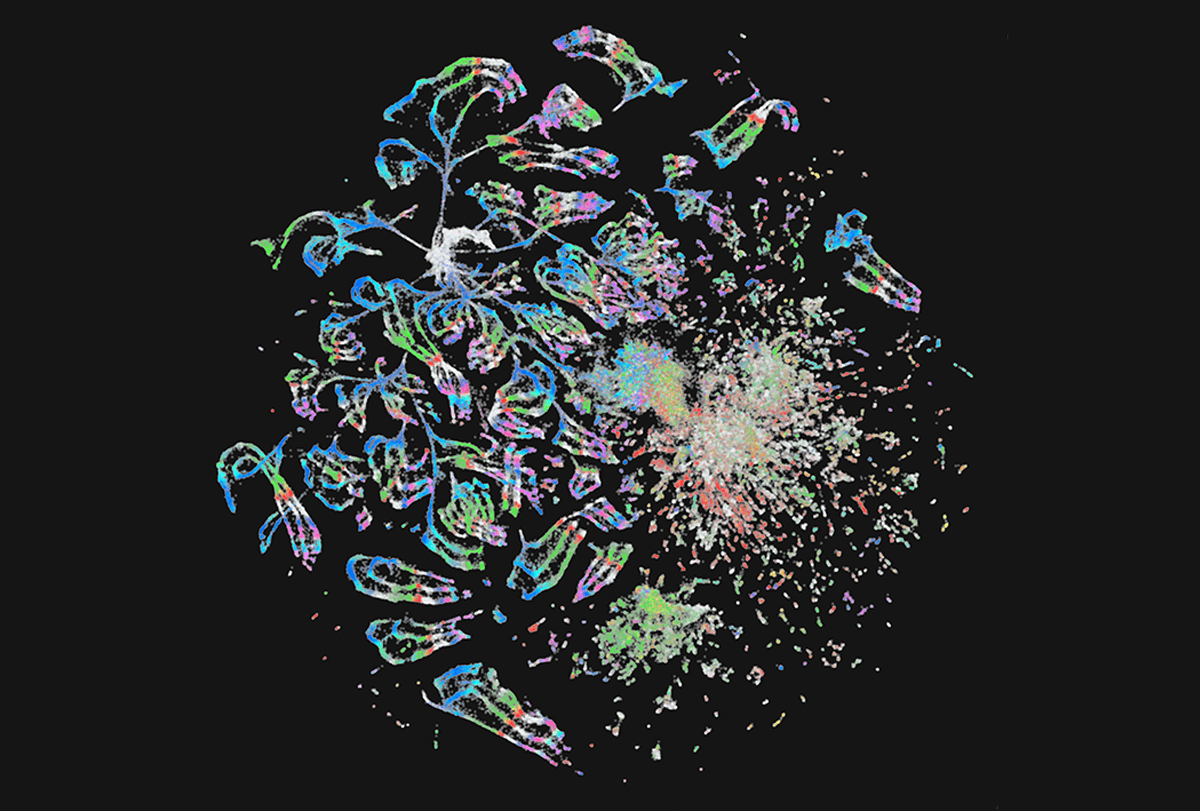
By sequencing more than 379,000 cells from flies of four different developmental stages, the researchers created an atlas of gene expression in the nerve cord across development. From there, they identified the markers of 34 cord hemilineages and 17 transcription factors that encode neuronal birth order. Donà, who is Italian, was amused by the finding, as 17 “is an unlucky number in Italy.”
Together, these factors act like a molecular time stamp, carrying information about when a neuron was born, and could potentially “explain a large degree of diversity,” Donà says.
Artificially expressing one factor outside its normal temporal window changed the neurons’ molecular identity, morphology and projections, the team showed—evidence that the code helps shape what kinds of neurons develop.
M
any of the transcription factors identified in the two studies do not disappear once a neuron has acquired its identity. Instead, they are expressed into adulthood, suggesting that they may also help a cell maintain its identity later in life. One possibility is that “maybe, evolutionarily, it was just cheaper to leave them on,” Zipursky says.Together, the two studies point toward a layered model of neuronal identity. First, a hemilineage-specific gene-expression code establishes a neuron’s broad family and overall anatomical plan. A birth-order code then helps generate different subtypes within that family.
“To me, it’s very profound that you have the clock—which, all the cells are following the clock—and they integrate whatever their specification is into that clock,” Zipursky says.
Sex-specific factors further refine neuronal identities rather than creating entirely distinct types, both studies suggest. Clowney compares this layer to “getting dressed”—the final accessory added to an outfit.
Decoding these layers could ultimately reveal how developmental genes guide the wiring of neural circuits, Jabaudon says.
But whether a similarly systematic code exists in vertebrates remains unclear. The next step might be to try the same experimental methods in rodents, Donà says. “It’s going to be possible if people maybe can focus on two or three lineages and at very high resolution,” she says. “And, of course, it’s very expensive because it’s going to need a lot of cells to be sequenced, but it’s doable.”