LISTEN TO THIS STORY:
0:00
/
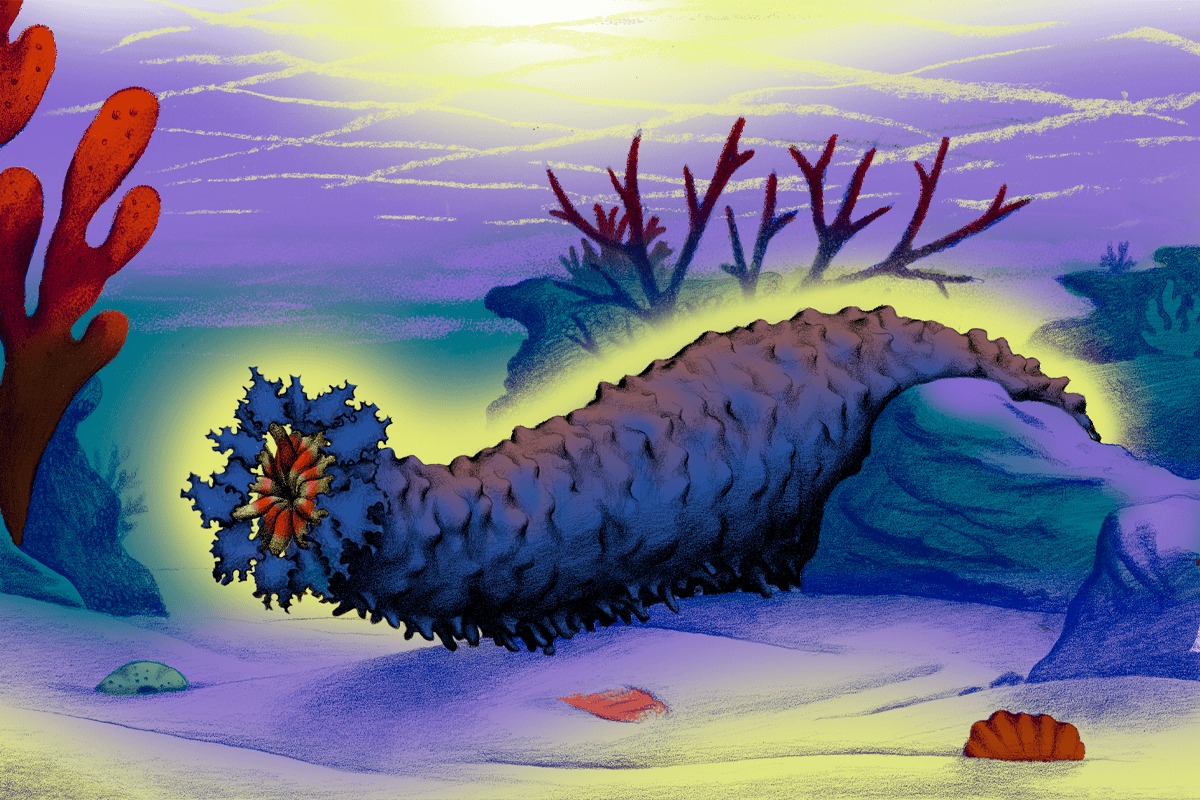
José E. García-Arrarás studies how these marine invertebrates manage to regrow their nervous system, intestines and other internal organs in a matter of months after threats prompt them to literally spill their guts.
Leia este artigo em português.
When José E. García-Arrarás needs more animals for his lab, he cannot just put in an order. Instead, he and his students head to the local beach.
García-Arrarás, professor of biology at the University of Puerto Rico, Rio Piedras, studies Holothuria glaberrima, a species of sea cucumber. These lumpy, vegetal invertebrates wriggle across the seafloor until low oxygen levels, parasites or the appearance of a predator prompts them to shoot all of their internal organs out of their mouths. Remarkably, they then regenerate their viscera as well as their nervous system within five months.
García-Arrarás investigates the cellular and genetic mechanisms that make this feat possible. Unlike axolotls and sea urchins, which are commonly studied for their own regenerative powers, sea cucumbers are almost entirely soft bodied, with no bones or endoskeleton.
“It saves the day not to have to do an extra amount of work to dissolve the calcium particles that are embedded in the tissue,” García-Arrarás says.
García-Arrarás spoke with The Transmitter about what’s on his tool wishlist, the cellular stars of regeneration and the parts of the world that sea cucumbers call home.
This interview has been edited for length and clarity.
The Transmitter: Why are sea cucumbers such a good model in which to study regeneration?
José E. García-Arrarás: First of all, it’s a very available animal model. Here in Puerto Rico, they are very abundant in the wild. We just go to the ocean to get them, as we cannot buy them or ship them.
Their regeneration powers are very strong; they can regenerate many different organs and structures—nervous system, intestine, respiratory system, and in some species even an entire half of the body. The other thing is that they don’t have a skeleton.
TT: What are their nervous systems like?
JGA: The sea cucumber has a nerve ring in the anterior part, and five radial nerve cords attached to it. Those nerves have a lot of neurons, but it’s not really a network; it’s more like having five nerve cords attached to the brain. When people think about radial nerves, they think of fibers. But this is a cord, similar to what vertebrates have. In the spinal cord, for example, there are both neurons and fibers running through it.
We have been looking at the types of cells, and the regeneration power of nerve cords. If we cut one, we’re looking at how they bridge the gap and form new neurons, and in about a month, you have a stretch of nervous system that looks normal.
TT: What have you learned about how this regeneration takes place?
JGA: Glia cells are deeply involved. The latest finding we just published last year is that these glia share a lot of markers that are expressed with vertebrate glia. We think that the glia are the main player in the regeneration process. We are finding now that in order to regenerate, those cells lose their biological properties and change their gene expression. They become what we call the de-differentiated glia, so they all become the same cell type, before differentiating into the neurons.
TT: What do you plan to study next?
JGA: With the single-nucleus RNA experiments we’re doing, what we’re aiming at is to see the stages at which the cells are changing their gene expression and what they are becoming. Do glia become differentiated glia? Do they all become the same cell type? Are these cells all pluripotent, meaning they can give rise to anything, or do they keep the differences between them? That’s part of the ongoing analysis.
TT: What scientific tools are on your wishlist?
JGA: What we want to do right now is to be able to inhibit RNA expression in vivo. The technique we use is not optimal: we cut the nerve and, at the same time, electroporate it to deliver small oligonucleotides that interfere with a gene’s expression. The problem is that every time we want to lower the expression of that RNA, we have to cut and electroporate, so we cannot follow the healing because we’re cutting all the time. We are looking into different methods of doing it.
TT: What do you want other scientists to know about this model?
JGA: I think there are two different things. One is the glia side of it—the function of glia in regeneration. The other thing, which for me is amazing, is the characterization of echinoderm neurons. Very little is known about what neuronal types are there. But we found different neuropeptide receptors, such as kisspeptin and galanin receptors. That shows that some of these neuropeptide systems are evolutionarily ancient. Kisspeptin is one of the peptides involved in sexual maturation in humans, and apparently, it could have a role in sexual maturation in these animals as well.
TT: Are there other countries where researchers also focus on sea cucumbers?
JGA: They have other species in China, where they also look at regeneration, alongside growth and development. Actually, the first full genome sequence of a sea cucumber was done by a Chinese team. There are also groups in Japan, Russia, England and the United States. They are pretty international animals!