LISTEN TO THIS STORY:
0:00
/

Shifting the focus of equity initiatives from identity categories to structural barriers can reveal overlooked challenges and increase support and participation worldwide.
Leia este artigo em português.
Definitions of underrepresentation in neuroscience often center on a familiar set of demographic categories: gender, race and ethnicity, disability, and socioeconomic background. These classifications underpin most equity initiatives and have contributed to broadening participation. These categories, however standardized, focus on who people are—not on what systems make progress harder for them. This distinction, between identity and infrastructure, has significant consequences for who gets counted, who gets supported, and who continues to fall through the gaps.
For example, consider a researcher presenting their work in a second language, or a first-generation graduate student with no previous knowledge of how academic careers work, and no family network to absorb the financial shocks along the way. Or envision a scientist who spends months navigating visa applications just to attend a conference they’ve been invited to. These researchers are not outliers, yet they aren’t as easy to track with underrepresentation categories that exclusively rely on demographics.
Historically, our field has used definitions of underrepresentation built around demographic categories drawn from national equality legislation and census data. Some forms of underrepresentation are genuinely region-specific, such as caste identity in India or Indigenous status in New Zealand, for instance. But many diversity, equity and inclusion (DEI) initiatives designed to address these challenges overlook barriers faced by people with intersecting marginalized identities. Moreover, common proxies such as World Bank income classifications or the “Global South” can be deeply misleading—some high-income countries invest less in research as a proportion of GDP than lower-income ones, and political shocks can collapse a country’s research capacity faster than any dataset can track.
As members of the ALBA Network—a global community committed to fostering DEI in the brain sciences—we have examined these gaps closely. To address them, we argue that the field needs a more holistic approach to defining underrepresentation in global neuroscience.
We propose a broader definition that incorporates well-documented barriers to scientific participation—including the compounding disadvantages faced by LGBTQIA+ professionals; visa and mobility constraints that limit international collaboration; the invisible tax of caregiving that falls disproportionately on women; forced displacement; first-generation university status; non-native English fluency; and working countries with chronically underfunded research infrastructure.
W
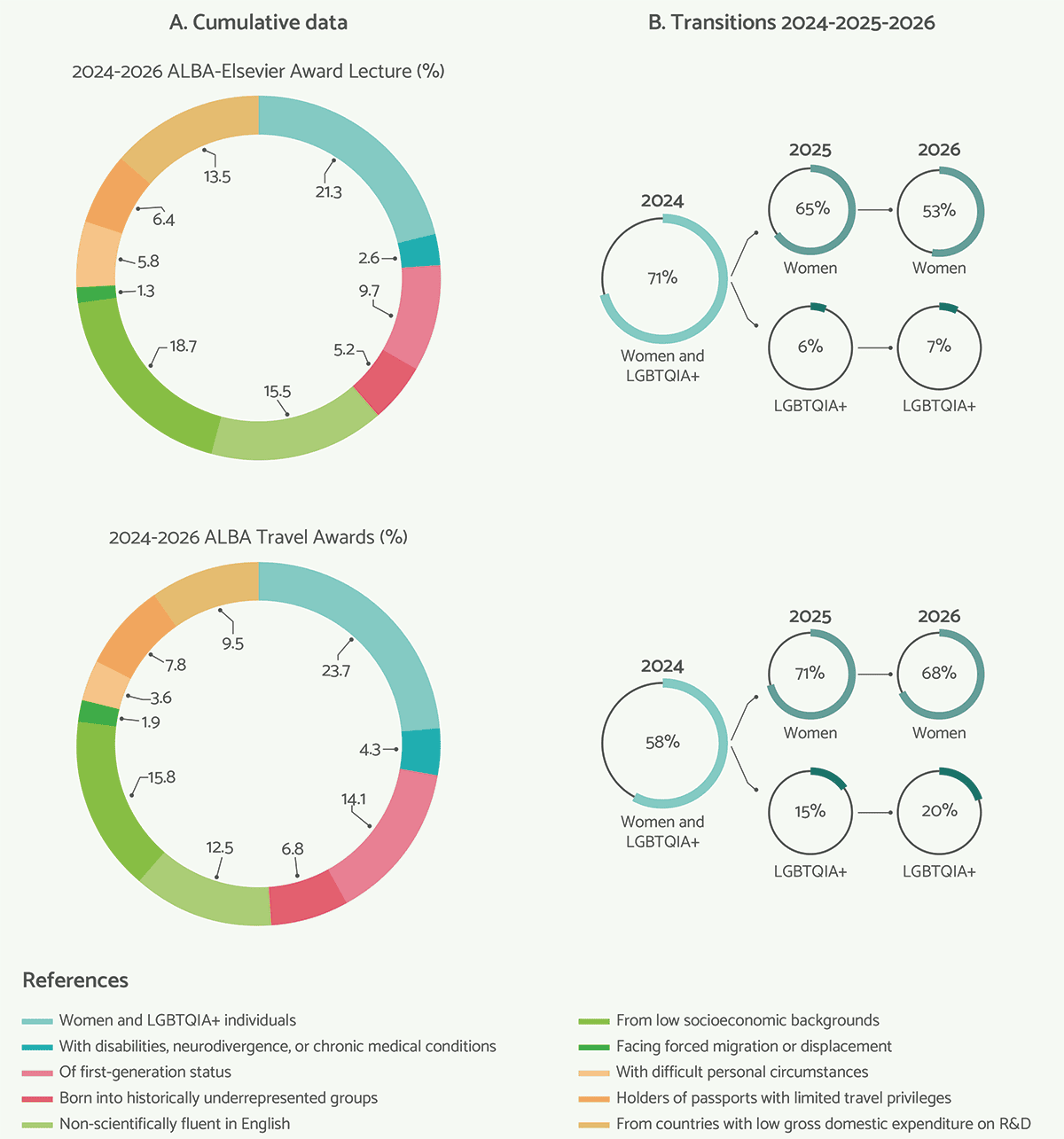
hat happens when you actually apply this definition? Since 2024, we have used it in granting ALBA awards, asking applicants to identify which barriers apply to their situation and to contextualize their achievements accordingly.The change has surfaced insights into our applicant population that standard definitions might have missed entirely. Across all three award cycles, the most consistently selected barriers were being a woman, a first-generation university attendee, a non-native English speaker or from a lower socioeconomic background. Passport holders with restricted travel appeared in 24 percent of our travel award applications across all three cycles—and notably higher than among lecture nominations. Representation of researchers working in countries with chronically low investment in research and development increased from 35 percent in 2024 to 47 percent in subsequent cycles, challenging the assumption that research excellence can be found only in well-resourced environments. And displaced researchers, who are navigating forced migration due to conflict or political instability, appeared at low but non-zero levels throughout.
Perhaps the most methodologically instructive changes came from refinements introduced between cycles. In 2024, we grouped women and LGBTQIA+ applicants into a single category—one of the most frequently selected. When disaggregated from 2025 onward, LGBTQIA+ identification dropped sharply across award types, suggesting that the prior aggregation had obscured differences within the combined category.
Our definition of underrepresentation is designed to be globally inclusive, but this risks losing the precision needed to direct resources where they are most needed. There is also a subtler problem: Many researchers do not perceive themselves as underrepresented, even when they face documented disadvantages—particularly women, who despite well-evidenced structural barriers often do not identify with the label.
Cultural stigma and privacy concerns further suppress disclosure among LGBTQIA+ neuroscientists, meaning that even well-designed forms undercount them. The category of “non-native English speaker” illustrates a related complexity. For Latin American researchers, it captures a concrete barrier—producing science in a language that is not their own; in regions where English was imposed through colonialism, however, researchers may be fluent but face bias around their accent.
Addressing these limitations requires not just methodological refinement but a shift in how our field evaluates achievement alongside eligibility. Some initiatives are already pointing in the right direction. The Australian NHMRC’s Relative to Opportunity policy explicitly instructs reviewers to interpret research productivity in light of career disruptions and structural constraints. The ALBA-Roche Prize for Excellence in Neuroscience Research applies the same principle, evaluating nominees’ scientific achievements relative to their circumstances. Similarly, the BNA Scholars Programme uses broad eligibility criteria beyond conventional academic indicators, offering another example of a more contextual approach to DEI program eligibility.
Context is everything, and some tension between global frameworks and local realities is inevitable. But that tension is generative: A shared global lens reveals challenges across borders, whereas local perspectives keep responses grounded and realistic. ALBA’s framework is not prescriptive. Our recommendation for other organizations is not that they should adopt ALBA’s parameters wholesale, but to treat underrepresentation itself as an empirical question—one whose answer should be revised iteratively, not fixed in advance by legislation or census categories. Neuroscience loses talent along fault lines of passport, language, geography and circumstance. The first step toward addressing that loss is deciding to measure it. If the field wants to broaden participation globally, it must measure not only who researchers are and what they produce, but also what they are required to overcome.
Acknowledgement: The ALBA Network is a division of FENS and is supported by its founding partners: FENS, IBRO and SfN.